Industry related headlines to keep you in the know.
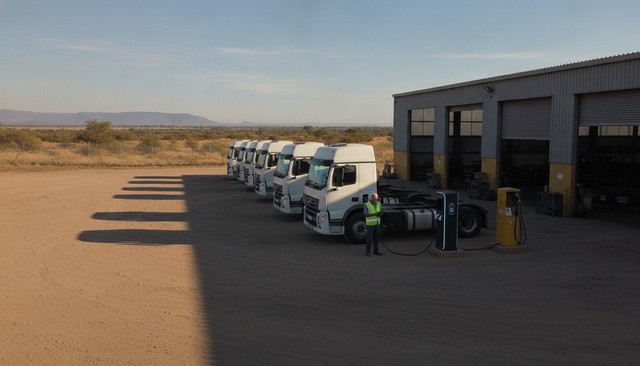
Volvo's heavy-duty electric range has been named International Truck of the Year 2027 at IAA Transportation 2026 in Hanover, while FAW used the same show to unveil a concept truck built around a chassis that can accept diesel, battery-electric, plug-in hybrid, CNG/LNG or hydrogen fuel-cell powertrains. Both announcements point at the same problem on a SADC fleet manager's desk: what do you buy when you cannot see ten years ahead?
ASSET MANAGEMENT
20 September 2026 • 6 min read
A truck bought in Southern Africa today is often still working in a second or third owner's fleet fifteen years later. That makes the powertrain choice a residual-value bet, not just an operating-cost one — and Hanover has just made the bet harder to place.
The International Truck of the Year 2027 award went to Volvo Trucks' heavy-duty electric range — the FH Electric, FM Electric, FMX Electric and FH Aero Electric — with the latest generation offering a claimed driving range of up to 700 km. Volvo Trucks president Roger Alm accepted the award in Hanover and said demand for the new electric trucks was strong, with "the order book almost full". The jury, chaired by Florian Engel, specifically credited Volvo's strategy of building a broad electric portfolio rather than one flagship model.
FAW took a different route to the same question. Its TL.X Visionary Concept Truck, designed with 2036 in mind, is built on a modular chassis intended to accept diesel, battery-electric, plug-in hybrid, CNG/LNG and hydrogen fuel-cell powertrains, alongside drive-by-wire systems, predictive diagnostics and autonomous capability. According to the concept's description, the modular approach could reduce the cost of changing from one powertrain to another by as much as 70%, rather than requiring replacement of the whole truck. The TL.X is a concept, not a production vehicle, and FAW has not announced any build programme for it.
Electric fleet in service: Volvo began producing electric trucks in 2019; roughly 7 000 units have since covered a combined 500 million kilometres, with nearly 2 000 customers operating them in more than 50 countries across eight models. (Source: Volvo Trucks via SA Trucker, 2026)
A 700 km claimed range moves battery-electric trucks out of the urban-distribution box and into regional work, which matters. But range is only the first of several constraints, and in Southern Africa it is rarely the binding one. Charging infrastructure along the N1, N3 and the Trans-Kalahari and Walvis Bay corridors remains thin; depot power availability and electricity cost are live variables; payload penalties bite on weight-limited loads; and turnaround times at borders and terminals are unpredictable in ways that a European duty cycle is not.
The jury's own criteria are instructive here: it assesses technological innovation, safety, driver comfort, energy efficiency, environmental impact and total cost of ownership. TCO calculated on a European corridor with dense charging is not TCO calculated on a Windhoek–Lubumbashi run. The award is a genuine signal about where the global product line is heading; it is not a purchase recommendation for a SADC long-haul operator.
Read together, the two announcements describe a market in which the manufacturers themselves are hedging. One builds breadth across eight electric models; the other designs a chassis that assumes the operator will want to change technology mid-life. Both are answers to the same uncertainty, and that uncertainty is precisely what a fleet buyer in Windhoek, Gaborone or Lusaka is being asked to absorb in a replacement cycle decision.
FAW's place in the SADC market makes its direction of travel worth noting regardless of whether the TL.X is ever built. The company launched the Jiefang CA10 in 1956, has since expanded into 115 countries and regions, and reports cumulative production and sales approaching 10 million vehicles — and it is already a volume brand on Southern African roads. A manufacturer of that scale publicly designing around powertrain substitution is a statement about what it expects buyers to demand in the next cycle.
Before your next replacement cycle, separate your routes into those where an electric or alternative-fuel unit could plausibly work — fixed daily distance, overnight depot charging, predictable payload — and those where it cannot yet. Then ask your dealer two questions in writing: what the local parts, battery-service and technician support looks like, and what residual value they are prepared to underwrite. Those answers, not a range figure from Hanover, will decide the TCO on your fleet.
Stay connected with Southern Africa's freight and transport community.
Join 6,400+ logistics professionals across the SADC region.
Visit Laaimylorrie.com| About the Author | |

|
Andre Klynsmith Entrepreneur & Technology Enthusiast Andre's expertise spans technology, blockchain, transport, and logistics — with a passion for innovation and driving positive change across industries. |
| Source: SA Trucker View source › | 16–17 September 2026 |


Subscribe to our Newsletter and stay in the know with all the latest Industry News, Products and Trends covering the whole of the SADC region.
KS Blockchain T/A Laaimylorrie.com . All Rights Reserved.