Industry related headlines to keep you in the know.
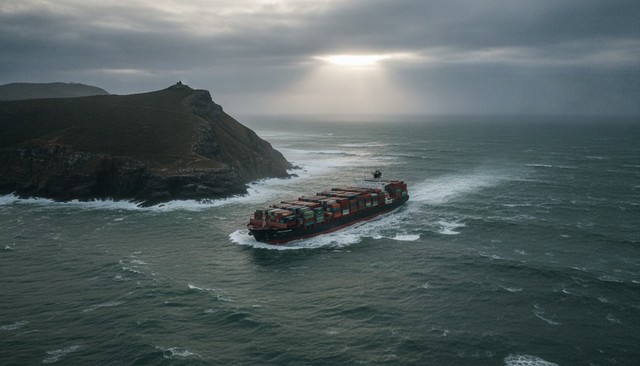
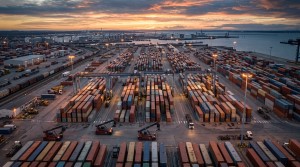
Asia-Europe container rates are sliding, and the reason is not that the Red Sea has become safe. It is that Asian port congestion has reached 4.3 million TEU and carriers are pulling capacity back through Suez to clear it.
Economy and Markets
17 September 2026 • 4 min read
Cape of Good Hope diversions are currently absorbing an estimated 5% to 7% of global container capacity — roughly 1.7 to 2.4 million TEU. That figure is both the cause of soft rates and the size of the traffic Southern African ports stand to lose. Cheaper boxes and thinner Cape calls are the same event.
Sogese’s September Europe Container Market Update, reported by Container News, sets out the shift. Drewry’s World Container Index put Shanghai-Genoa at US$4,368 per 40-foot container on 3 September, down 10% week on week, with Shanghai-Rotterdam down 5% to US$4,092. Blank sailings on Asia-Europe were set to fall from four to one the following week — an early sign of capacity coming back into the market.
Sogese CEO Andrea Monti framed the wider picture bluntly: “The container market is becoming less global in the way it behaves.” Demand, rates and available capacity, he said, are increasingly moving in different directions on different trade lanes. On what is actually driving the move, he was equally direct: “Congestion has become the more urgent variable.”
Congestion above the pandemic peak: Asian port congestion stood at 4.3 million TEU when the report was compiled — above the 4 million TEU recorded at the peak of the pandemic. (Source: Linerlytica data cited in Sogese September Europe Container Market Update, via Container News, 2026)
A longer voyage ties up ships. That is the whole mechanism. With Cape routing holding an estimated 1.7 to 2.4 million TEU of the world fleet in transit rather than working cargo, a carrier facing 4.3 million TEU of congestion has an obvious lever: shorten the rotation, get the vessel back into service faster, and recover productivity without ordering a single new ship.
Sogese believes the selective return of Suez services could release effective capacity into Asia-Europe faster than carriers can manage through blank sailings alone — which is precisely why rates are softening ahead of any improvement in the security picture. The report also notes that carriers are not making uniform network changes: Ocean Alliance, Maersk, COSCO and OOCL have all been adjusting individual services, vessel deployments and port rotations rather than moving whole networks at once.
Sogese’s central expectation is a gradual, congestion-driven return to Suez over coming months, improving vessel productivity and progressively lifting effective capacity on Asia-Europe. Rates are expected to soften gradually rather than fall sharply, with Suez services expanding selectively rather than in a network-wide switch, and carrier changes remaining tactical rather than structural.
Read that as a warning about planning conditions, not just prices. Route-by-route recalibration means more frequent changes to port rotations, sailing frequencies and transhipment arrangements — and a transhipment arrangement is the thing that decides whether a Southern African box moves this week or next.
Do not read falling rates as a calmer market. The same capacity release that lowers your per-container cost also removes vessel calls, bunker demand and ad-hoc port service revenue from Cape ports — so importers and Cape-route service providers should be planning in opposite directions. Importers: lock what you can while the index is easing. Port-adjacent businesses: treat diverted-traffic revenue as cyclical, not structural, and confirm your carrier’s transhipment port before you commit an inland truck slot.
Stay connected with Southern Africa's freight and transport community.
Join 6,400+ logistics professionals across the SADC region.
Visit Laaimylorrie.com| About the Author | |

|
Andre Klynsmith Entrepreneur & Technology Enthusiast Andre's expertise spans technology, blockchain, transport, and logistics — with a passion for innovation and driving positive change across industries. |
| Source: Container News View source › | 9 September 2026 |


Subscribe to our Newsletter and stay in the know with all the latest Industry News, Products and Trends covering the whole of the SADC region.
KS Blockchain T/A Laaimylorrie.com . All Rights Reserved.