Industry related headlines to keep you in the know.
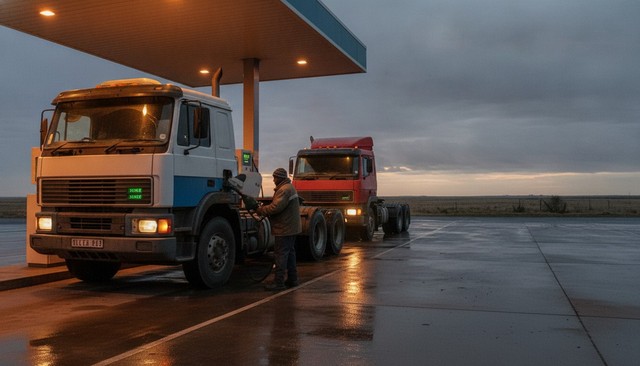
South African wholesale diesel rose to R29.11 a litre for 500ppm and R30.05 a litre for 50ppm at the start of September - increases of 11.23% and 11.71% respectively in a single adjustment - and the Road Freight Association warns that operators already struggling to hold sustainable rates are now facing a cost line that can end a transport business inside a contract term.
Fleet Management
15 September 2026 • 4 min read
"Transport companies can disappear virtually overnight when their contracts and rates become unsustainable." That is the RFA's chief executive describing an ordinary September - not a crisis month, not an exceptional event. A double-digit diesel move inside a fixed-rate contract is a solvency event, not a margin event.
The September adjustment was driven primarily by higher international product prices, but two domestic components sat inside it as well: an additional 4.9 cents a litre associated with the wage increase for forecourt employees, and 21.9 cents a litre for the slate levy. Both grades of petrol also rose 5.27%, taking 93 unleaded and lead replacement petrol to R26.76 a litre and 95 unleaded and lead replacement petrol to R26.92 - a cost that lands on operators running smaller petrol-powered delivery vehicles rather than heavy diesel units.
"Every litre of fuel consumed on South Africa's roads affects the underlying health of the country's logistics economy," said RFA chief executive Gavin Kelly. "Changes in fuel prices have a far-reaching effect on the country's supply chain, transport systems, the wider logistics industry as well as the pricing of goods on store shelves."
One month, one line item: Wholesale diesel at R29.11/litre (500ppm) and R30.05/litre (50ppm) from the start of September - up 11.23% and 11.71% respectively, including 21.9 c/l of slate levy. (Source: Road Freight Association via Freight News, 2026)
Kelly's point to the Transport Forum was that rate sustainability is the single biggest challenge facing the road freight sector, and that the drivers of rate change are frequently outside operator control. Fuel is the clearest case. It is the largest variable cost in a line-haul operation, it cannot be substituted, it cannot be deferred, and an 11% move arrives in full within a single fuelling cycle - long before a rate review, a fuel clause trigger or a customer conversation can catch up with it.
Upcoming wage negotiations will add a second uncontrolled input on the same books. An operator carrying a fixed rate through both will be absorbing two cost increases against unchanged revenue, and cash flow - not profitability - is what fails first. Small and owner-driver operators have the least room here, because they typically hold the shortest working-capital buffer and the weakest position to reopen a rate.
Kelly raised a second pressure that runs alongside fuel: operators need strong technical expertise while complying with an expanding range of legal and regulatory requirements, and the cost of that compliance is made harder by operators who do not carry it. "It doesn't help if you're meeting all the rules, which is expensive, and others aren't and actually push you out of the business." He also noted that corruption and extortion compound the pressure, with the RFA receiving multiple complaints from operators involving various levels of authority.
For cross-border operators the arithmetic is wider still. A truck running from Gauteng to Lusaka, Harare, Gaborone or Walvis Bay buys fuel under more than one pricing regime, each with its own levy structure and adjustment calendar. A South African increase of this size changes the economics of where a vehicle refuels on a route - and that routing decision is now worth real money per trip rather than a rounding difference.
Audit every contract for a working fuel adjustment clause and check that it is indexed to a published price with a trigger that fires monthly, not quarterly - an 11% move will destroy a quarterly mechanism. Recost your routes for refuelling point rather than assuming the cheapest leg is still the cheapest. And separate cash-flow planning from margin planning: fuel increases hit cash immediately and margin later, and it is the cash gap that closes businesses.
Stay connected with Southern Africa's freight and transport community.
Join 6,400+ logistics professionals across the SADC region.
Visit Laaimylorrie.com| About the Author | |

|
Andre Klynsmith Entrepreneur & Technology Enthusiast Andre's expertise spans technology, blockchain, transport, and logistics - with a passion for innovation and driving positive change across industries. |
| Source: Freight News View source › | 13 September 2026 |





Subscribe to our Newsletter and stay in the know with all the latest Industry News, Products and Trends covering the whole of the SADC region.
KS Blockchain T/A Laaimylorrie.com . All Rights Reserved.