Industry related headlines to keep you in the know.
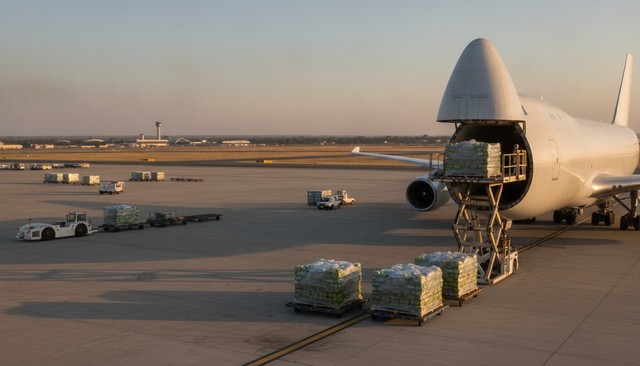
African airlines grew air cargo demand by just 1.1% year on year in July 2026 while adding 4.1% more capacity — the weakest demand performance of any region in a month when the global market grew 3.9%.
Aviation
15 September 2026 • 3 min read
When capacity grows nearly four times faster than demand, load factors fall and rates follow. African carriers' cargo load factor dropped 1.4 percentage points to 45.8% in July, the sharpest decline of any region. For SADC shippers, that is a buyer's market opening up on a continent that carries only 2.1% of world air cargo.
The International Air Transport Association reported global air cargo demand, measured in cargo tonne-kilometres, up 3.9% year on year in July 2026, with international operations up 4.7%. Capacity rose 1.7%, lifting the global load factor by one percentage point to 46.0%.
Africa was the outlier in the wrong direction. Demand grew 1.1%, the weakest of all regions, while capacity expanded 4.1% — the second-fastest capacity growth after Latin America. North American carriers, by contrast, grew demand 4.8% while cutting capacity 1.5%, which is why their load factor jumped 2.5 points.
Africa in July 2026: Demand +1.1%, capacity +4.1%, load factor 45.8% (down 1.4 percentage points). Africa holds 2.1% of world cargo tonne-kilometres. (Source: IATA, 2026)
IATA chief economist Marie Owens Thomsen noted that Asia-Pacific, Europe and North America accounted for more than 90% of the overall increase, and that dedicated freighters gained market share as belly-hold traffic declined. That shift has a direct African read: much of the continent's air cargo capacity rides in the holds of passenger aircraft, so a market rotating towards freighters leaves belly-dependent networks carrying more empty space.
The trade lane data reinforces the picture. Asia–North America grew 9.2% and Europe–Asia 3.1%, while Gulf-linked corridors contracted sharply: Europe–Middle East fell 16.1% and Middle East–Asia 14.1%, both now five consecutive months of decline under the Middle East conflict. African networks that feed Gulf hubs are exposed to exactly those contracting lanes.
Jet fuel rose 12.2% month on month in July and sat 56.9% higher than a year earlier. Carriers absorbing that increase into a falling load factor will not hold soft rates indefinitely. Global trade grew 7.5% year on year and the manufacturing PMI remained in expansion at 52.7, so the underlying demand signal is not the problem — Africa's share of it is.
For SADC exporters, the practical window is narrow. Soft African load factors mean space is available and negotiable now, particularly for perishables, horticulture and mineral samples moving out of Johannesburg, Nairobi-routed connections and Windhoek. That window closes if fuel costs force capacity discipline later in the year.
Negotiate air freight allocations now while African load factors sit below 46% and carriers are chasing volume. Check whether your routings depend on Gulf hubs, because those lanes have contracted for five straight months and re-routing takes lead time. And treat the 56.9% year-on-year jet fuel increase as the clock on this soft patch — lock rates where you can rather than assuming spot availability in the fourth quarter.
Stay connected with Southern Africa's freight and transport community.
Join 6,400+ logistics professionals across the SADC region.
Visit Laaimylorrie.com| About the Author | |

|
Andre Klynsmith Entrepreneur & Technology Enthusiast Andre's expertise spans technology, blockchain, transport, and logistics — with a passion for innovation and driving positive change across industries. |
| Source: IATA View source › | 31 August 2026 |


Subscribe to our Newsletter and stay in the know with all the latest Industry News, Products and Trends covering the whole of the SADC region.
KS Blockchain T/A Laaimylorrie.com . All Rights Reserved.