Industry related headlines to keep you in the know.
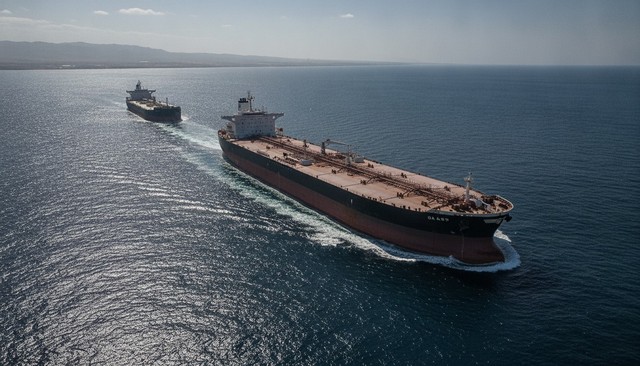
The cost of hiring a crude tanker on the industry's benchmark Persian Gulf to China route passed one million dollars a day for the first time on Monday, with Baltic Exchange data putting the rate at $1.035 million a day.
Economy and Markets
15 September 2026 • 3 min read
The headline number matters less than the gap beneath it. The same class of ship loading in the Gulf of Oman, which requires no transit of the Strait of Hormuz, earns about $644 000 a day. The difference between the two is the market's price for crossing the line — roughly $391 000 a day, quoted in public, every day.
Very large crude carriers hauling oil from inside the Persian Gulf to China were being hired at $1.035 million a day, according to Baltic Exchange data reported by Bloomberg. In poor markets in the past, the same vessels have sometimes barely covered their running costs. The Gulf of Oman comparator at roughly $644 000 a day is not a cheap rate by any historical standard either — it simply does not carry the war premium attached to entering the strait.
Several forces are stacked on top of each other. Refining margins have spiralled because the wars in Iran and Ukraine mean the world is not producing enough finished fuel, so refiners keep buying and shipping whatever crude they can get. At the same time, disruption to Saudi flows from Yemen's Houthi forces has pushed some cargoes onto a voyage around Africa that is thirty days longer, absorbing vessel capacity that would otherwise be available elsewhere.
The chokepoint premium: $1.035 million a day for Persian Gulf to China against about $644 000 a day for Gulf of Oman to China — and some Saudi cargoes now sailing a voyage thirty days longer around Africa. (Source: Baltic Exchange data reported by Bloomberg via gCaptain, 2026)
There is an important caveat buried in the record. The Persian Gulf to China route has become less representative during the war, because the main way Gulf oil now reaches the market is by shuttling barrels out through Hormuz in smaller parcels for collection just outside the strait by tankers that will not go in. The benchmark still prints, but a shrinking share of the actual trade is being done on it.
That matters for anyone using tanker indices as a proxy for energy cost. A record on a route that fewer ships are willing to serve tells you about scarcity of nerve as much as scarcity of tonnage. The shuttle model itself also consumes vessel time — every transfer adds days to a voyage that used to be a single lift — which quietly removes capacity from the world fleet without a single ship leaving the water.
Container rates have stayed notably calm through the same period. Drewry's World Container Index was assessed at $4 476 per 40ft container on 10 September, unchanged for a second consecutive week. The two markets are being driven by different things: tankers by war risk at a single chokepoint, boxes by demand, vessel supply and the gradual return of Asia–Europe services to the Suez Canal.
For SADC importers and exporters, that divergence is the practical planning point. The pressure from this crisis is arriving through fuel and through anything with a hydrocarbon input — diesel, bunkers, fertiliser, plastics, bitumen — rather than through the ocean freight line on a container invoice. Budgeting as though the whole freight bill is about to move is the wrong shape of caution.
Separate your exposures. Model fuel and hydrocarbon-linked inputs on a war-premium basis and review your fuel surcharge mechanism now, while container rates are still flat enough to give you room. Do not use tanker headlines to justify a container rate increase to a customer — the index will not back you up — and make sure any fuel clause in a long-term haulage contract is indexed to a published pump or bunker price rather than to a negotiation you will have to reopen every month.
Stay connected with Southern Africa's freight and transport community.
Join 6,400+ logistics professionals across the SADC region.
Visit Laaimylorrie.com| About the Author | |

|
Andre Klynsmith Entrepreneur & Technology Enthusiast Andre's expertise spans technology, blockchain, transport, and logistics — with a passion for innovation and driving positive change across industries. |
| Source: gCaptain (Bloomberg) View source › | 14 September 2026 |


Subscribe to our Newsletter and stay in the know with all the latest Industry News, Products and Trends covering the whole of the SADC region.
KS Blockchain T/A Laaimylorrie.com . All Rights Reserved.