Industry related headlines to keep you in the know.
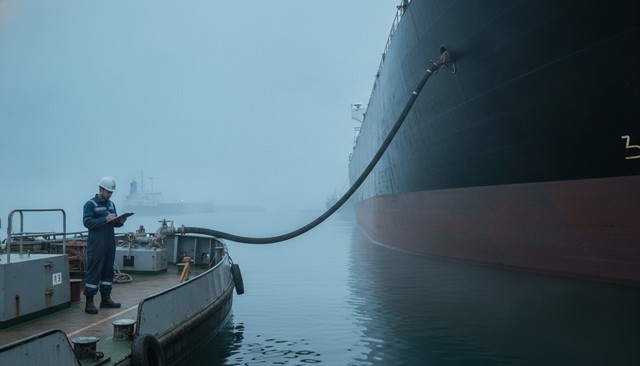
Two documents have carried most of the weight in maritime sanctions screening for years: a vessel's certificate of registry and its AIS track history. Both are now being faked at scale, and the commercial cost of accepting a forged one has shifted from the shipowner onto the supplier.
Technology and Trends
13 September 2026 • 5 min read
In the second quarter of 2026, 275 internationally trading tankers were broadcasting the flag of a fraudulent registry, and around 90% of them were under Western sanctions. Roughly 978 000 GPS jamming events were recorded globally in the first quarter. A clean-looking document set is no longer evidence of a clean vessel.
A fraudulent registry is not a lax flag state. It is an entity issuing certificates of registry for a flag it has no authority to grant - in some cases for a country that does not run an international register at all. The vessel then trades on paperwork that looks entirely conventional until someone attempts to verify it with the named administration.
The volumes involved are no longer marginal. Analysis covering the second quarter of 2026 identified 275 internationally trading tankers broadcasting the flag of a fraudulent registry, down slightly from 290 in the first quarter, spread across 22 such registries. Around 90% of the vessels using them were under Western sanctions. The registry certificate, in other words, has become one of the more reliable indicators that something is wrong - but only if it is verified rather than filed.
Signal interference: Approximately 978 000 GPS jamming events were recorded globally in the first quarter of 2026, with about 98% concentrated in the Middle East Gulf. (Source: Ship & Bunker, 2026)
The second check to fail is the AIS track. Screening tools routinely reconstruct where a ship has been from its broadcast positions and flag sanctioned calls. That method assumes the positions are real. With jamming at the scale recorded in early 2026 - overwhelmingly concentrated in the Gulf - a vessel can show an unbroken, unremarkable voyage history precisely because its actual calls were made behind corrupted coordinates.
This inverts a familiar assumption. An AIS gap has long been treated as the red flag. A continuous, tidy track now deserves scrutiny of its own, because a spoofed position sequence is cheaper to produce than a genuine detour and leaves no obvious hole in the record. The absence of an anomaly is not the same thing as the presence of compliance.
What makes this a commercial story rather than a compliance curiosity is where the exposure now sits. The European Union's 21st sanctions package, adopted on 23 July 2026, introduced 218 new listings and for the first time extended designation criteria to cover vessels providing services to shadow fleet ships - bunkering explicitly among them. Supplying fuel is no longer a neutral act performed on someone else's problem. Enforcement has followed: nine ships have been seized by French, Belgian, British and Swedish navies since the start of 2026, including stateless and falsely flagged tankers.
The pattern matters well beyond bunker barges. Across freight generally, the regulatory direction of travel is to hold the service provider responsible for verifying the counterparty, not merely for holding a copy of the counterparty's paperwork. A supplier, agent or forwarder that can show only that it received and stored a certificate has documented its own process, not the customer's legitimacy.
Southern Africa's ports sit on the Cape route that carries a large share of diverted tanker traffic, so regional bunker suppliers, agents and terminal service providers are inside this exposure whether or not they trade with sanctioned parties knowingly. Verify a certificate of registry with the named flag administration rather than accepting the document, and treat an unbroken AIS history from a Gulf-transiting vessel as a question rather than an answer. Keep a dated record of what you checked and with whom - the defensible position is evidence of verification, not possession of paperwork.
Stay connected with Southern Africa's freight and transport community.
Join 6,400+ logistics professionals across the SADC region.
Visit Laaimylorrie.com| About the Author | |

|
Andre Klynsmith Entrepreneur & Technology Enthusiast Andre's expertise spans technology, blockchain, transport, and logistics - with a passion for innovation and driving positive change across industries. |
| Source: Ship & Bunker View source › | 10 September 2026 |





Subscribe to our Newsletter and stay in the know with all the latest Industry News, Products and Trends covering the whole of the SADC region.
KS Blockchain T/A Laaimylorrie.com . All Rights Reserved.