Industry related headlines to keep you in the know.
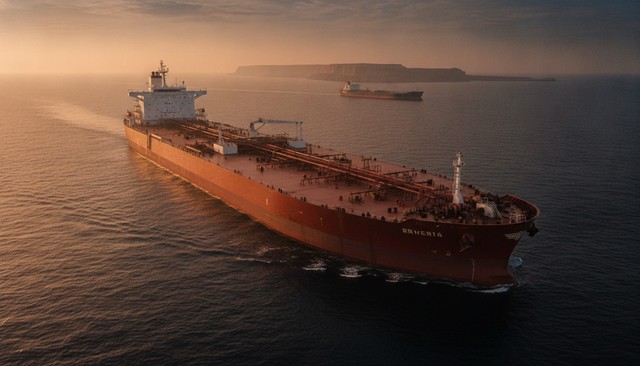
Earnings for supertankers on the benchmark Middle East to China route reached a record of nearly US$800,000 a day this week, and a charterer moving crude from the US Gulf to Asia was offered a very large crude carrier at a record lump sum of US$29.5 million. For SADC fuel importers and bulk commodity shippers, the significant fact is not the size of those numbers but what they mean: the cost of moving a barrel has stopped tracking the price of a barrel.
Mining and Commodities
12 September 2026 • 4 min read
Crude is up more than 40% since the war began. Tanker freight has more than doubled. When two cost lines move at different speeds, hedging only one of them leaves the other exposed — and freight is the one most SADC fuel contracts leave floating.
Bloomberg reported on 10 September that the US$29.5 million lump sum on the US Gulf to Asia run works out at close to US$15 a barrel before war-risk premiums or delay charges are added. The Baltic Exchange's tanker index, which tracks VLCC daily earnings across routes, has more than doubled since the conflict began in late February.
Forecasters do not expect a rapid correction. Data intelligence firm Kpler expects VLCC daily earnings to hold above US$100,000 a day into next year, against historic levels that rarely exceeded US$45,000. Morgan Stanley told clients two-year leasing rates for VLCCs could rise a further 20% to 30%.
A new benchmark, already up 85%: the Baltic Exchange began publishing an index for the Gulf of Oman to East Asia voyage and estimates daily earnings on that route have spiked 85% since inception, reaching almost US$386,000 a day this week. (Source: Baltic Exchange, reported by Bloomberg, September 2026)
Volume is not the binding constraint. The chief executive of trading house Vitol said this week that roughly 10 million barrels a day are still leaving the Gulf, largely through a shuttling arrangement that relies on vessels waiting in the Gulf of Oman. What has changed is that every barrel now travels further, waits longer and carries more insurance.
Alex Grant, global head of crude, products and liquids trading at Equinor, put it plainly at the Asia Pacific Petroleum Conference in Singapore: "There's quite a few bottlenecks all at the same time. The market is quite stressed with all of that, and that's showing up in the shipping rates." Max Tay of Repsol was blunter still, describing himself as "sort of enslaved to the freight market".
The clearest signal of how long the industry expects this to last is who is buying tonnage. Abu Dhabi National Oil Company has extended a US$2.7 billion ship-buying programme, and a senior Kuwait Petroleum Corporation executive has confirmed the company is buying more vessels rather than relying on commercially owned ones. Mitsui O.S.K. Lines chairman Takeshi Hashimoto summarised the industry's position: "We have to accept that relatively higher logistics cost, because so many alternative routes will be necessary instead of the Middle East."
For Southern Africa, the read-across runs through diesel, LPG and jet fuel landed cost, and through the bulk fleet that carries copper, chrome, manganese and coal. Tonnage that can earn record money hauling crude is tonnage that is not competing to lift dry bulk cheaply, and the pressure transmits across segments through owners' chartering decisions.
Ask your fuel supplier to show the freight component of the landed price separately from the product component, and check how often each is repriced. A contract that references a crude benchmark but leaves freight floating is only half hedged, and freight is currently the faster-moving half. For exporters, build charter-rate movement into commodity netback calculations rather than treating ocean freight as a fixed deduction.
Stay connected with Southern Africa's freight and transport community.
Join 6,400+ logistics professionals across the SADC region.
Visit Laaimylorrie.com| About the Author | |

|
Andre Klynsmith Entrepreneur & Technology Enthusiast Andre's expertise spans technology, blockchain, transport, and logistics - with a passion for innovation and driving positive change across industries. |
| Source: Bloomberg, via gCaptain View source › | 10 September 2026 |


Subscribe to our Newsletter and stay in the know with all the latest Industry News, Products and Trends covering the whole of the SADC region.
KS Blockchain T/A Laaimylorrie.com . All Rights Reserved.