Industry related headlines to keep you in the know.
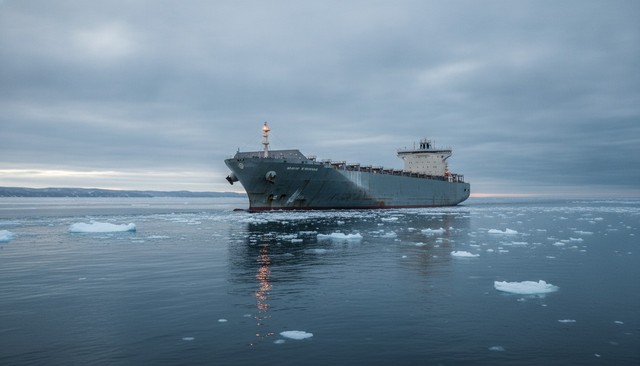
A container ship that left eastern China on 15 August arrived at Teesport in north-east England on 9 September, completing the first voyage of what is intended to become a regular Chinese container service to Europe via the Arctic. For Southern African ports that have spent two years absorbing traffic diverted around the Cape of Good Hope, the arrival of the Dubai Tower is a reminder that the detour was never guaranteed to be permanent.
Shipping and Logistics
12 September 2026 • 3 min read
Asia and Europe are now connected by three sea routes instead of two: Suez, the Cape, and the Northern Sea Route. Southern African ports have built a real business on the second of those. The third one has just proved it works.
The Dubai Tower sailed from eastern China on 15 August and berthed at Teesport on 9 September, a passage of twenty-five days by way of the Arctic Ocean. Reuters reported that the voyage is intended as the start of a scheduled container service to Europe on the so-called Northern Sea Route, and that the passage is significantly quicker than either a Suez transit or a rounding of the Cape of Good Hope.
A South Korean container ship is making a similar voyage, joining Chinese and Russian operators in testing cargo services along a corridor that faster sea-ice melt has made navigable for a longer part of the year. The commercial logic is not only distance. The Arctic passage avoids the Middle East entirely at a moment when the Strait of Hormuz is effectively closed and the Bab el-Mandeb is contested.
Twenty-five days: the Dubai Tower's passage from eastern China on 15 August to Teesport on 9 September — against Cape routing, which adds roughly two weeks or more to a standard Asia–Europe transit. (Source: Reuters, September 2026)
Since the Red Sea crisis began, the Cape sea route has carried volumes it was never designed for, and Southern African ports have earned real revenue from vessels that pass by: bunkers, stores, crew changes, spares and repairs. That business exists because carriers had no better option. It follows that the business shrinks as better options appear.
The Arctic corridor is not going to replace the Cape this year. Weather and ice conditions remain unpredictable, insurance and ice-class tonnage are scarce, and the commercial feasibility of a year-round schedule is unproven. But a single completed voyage changes the conversation from theory to trial, and trials attract capital.
There is a useful distinction between traffic that passes Southern Africa because the geography forces it to, and traffic that calls at Southern Africa because there is a commercial reason to stop. The first kind is on loan. The second kind — transhipment for African cargo, reliable compliant fuel, repair capability, bonded storage, inland corridor connections — is earned and does not disappear when a chokepoint reopens.
Every rand of infrastructure spending justified purely by diverted Asia–Europe volume is a bet that the diversion lasts. Spending justified by African import and export demand is not.
Treat the Cape volume windfall as cyclical, not structural, when you plan capacity or price a multi-year contract. If your business case for new equipment, yard space or a bunkering venture depends on diverted Asia–Europe traffic staying at current levels, stress-test it against a scenario in which Suez normalises and an Arctic service scales. Service quality that African importers and exporters will pay for is the part of the demand that stays.
Stay connected with Southern Africa's freight and transport community.
Join 6,400+ logistics professionals across the SADC region.
Visit Laaimylorrie.com| About the Author | |

|
Andre Klynsmith Entrepreneur & Technology Enthusiast Andre's expertise spans technology, blockchain, transport, and logistics - with a passion for innovation and driving positive change across industries. |
| Source: Reuters, via gCaptain View source › | 9 September 2026 |





Subscribe to our Newsletter and stay in the know with all the latest Industry News, Products and Trends covering the whole of the SADC region.
KS Blockchain T/A Laaimylorrie.com . All Rights Reserved.