Industry related headlines to keep you in the know.
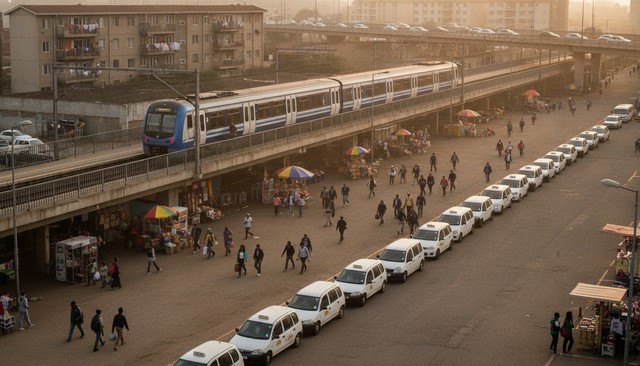
South Africa has spent more than two decades and billions of rand pursuing an integrated public transport system, and passenger rail is visibly recovering — yet the modes still do not connect, and the reason has less to do with track than with who controls the routes.
Public Transport
12 September 2026 • 4 min read
Writing ahead of October's annual transport showcase, Public Interest SA chair Tebogo Khaas argues the question is no longer whether South Africa knows what an integrated system looks like. It is why, after twenty years of policy and investment, the country has not built one.
The vision is not new. Johannesburg formulated its first Integrated Transport Plan in 2003, Cape Town and Tshwane followed, and the Public Transport Strategy of 2007 gave the approach national expression. Gautrain was designed from conception as more than a railway, with stations conceived as intermodal nodes supported by a dedicated feeder-bus network and connections to municipal services. The ambition was coordinated routes and schedules, seamless interchange and eventually integrated ticketing across rail, bus, bus rapid transit and minibus taxi.
The Passenger Rail Agency of South Africa has meanwhile made real progress recovering from the theft, vandalism and infrastructure plunder that intensified during the Covid-19 period. Dormant corridors and stations have been restored, infrastructure rehabilitated and modern commuter trains deployed into communities where rail had effectively disappeared. Khaas describes this as a glimpse of what is possible when rail takes its proper place at the centre of a network — and simultaneously as evidence of a policy implementation failure, because integration has not kept pace with reconstruction.
The scale of the private network: The minibus-taxi industry moves roughly 68% of the country's 5.4 million daily public transport passengers, is valued at more than R40 billion a year and supports around 300 000 jobs directly and indirectly. (Source: Parliament of South Africa / industry estimates, 2026)
Khaas identifies the minibus-taxi industry as the central obstacle, and is careful about why. His argument is not that taxis are unnecessary — they carry the majority of commuters and perform functions scheduled services cannot. It is that the industry, as recent testimony before the Madlanga commission of inquiry illustrated, appears to operate according to its own rules, with associations exercising powers that in practice resemble those of de facto regulators despite having no lawful mandate to regulate the broader public transport system.
That raises questions of power, governance and accountability that integration plans have generally avoided. The City of Cape Town has been explicit that its bus rapid transit system is intended to integrate rather than replace minibus taxis, and BRT construction is under way in Polokwane, Ekurhuleni, eThekwini, Mbombela, Msunduzi, George and Rustenburg. But an interchange only works if every operator accepts a common timetable, a common fare instrument and a common authority — and that is a governance settlement, not an engineering one.
Freight and passenger transport share arterials, fuel, workshops and a labour pool. When a commuter network cannot coordinate, congestion on urban corridors persists, and urban delivery windows narrow with it. More directly, the settlement now being debated for passenger transport — licensed operators, traceable trips, a recognised authority setting terms of access — is the same formalisation logic that accreditation, permits and telematics have already brought to road freight.
There is a service-standard dimension too. As commuters are trained by integrated ticketing and live tracking to expect transparent pricing and proof of journey, the same expectations migrate to the customers booking last-mile and urban distribution work. Operators who can already produce a tracked, timestamped, documented delivery record are ahead of that curve rather than chasing it.
Treat the integration debate as a leading indicator for urban road transport regulation generally — where passenger licensing, route authority and mandatory tracking go, freight permitting tends to follow. Plan urban and last-mile schedules around the assumption that arterial congestion in the metros will not ease materially in the short term, and keep credentials, permits and tracking records clean, because the direction of travel in both passenger and freight transport is toward operators who can prove what they did.
Stay connected with Southern Africa's freight and transport community.
Join 6,400+ logistics professionals across the SADC region.
Visit Laaimylorrie.com| About the Author | |

|
Andre Klynsmith Entrepreneur & Technology Enthusiast Andre's expertise spans technology, blockchain, transport, and logistics — with a passion for innovation and driving positive change across industries. |
| Source: Sowetan — Tebogo Khaas View source › | 8 September 2026 |


Subscribe to our Newsletter and stay in the know with all the latest Industry News, Products and Trends covering the whole of the SADC region.
KS Blockchain T/A Laaimylorrie.com . All Rights Reserved.