Industry related headlines to keep you in the know.
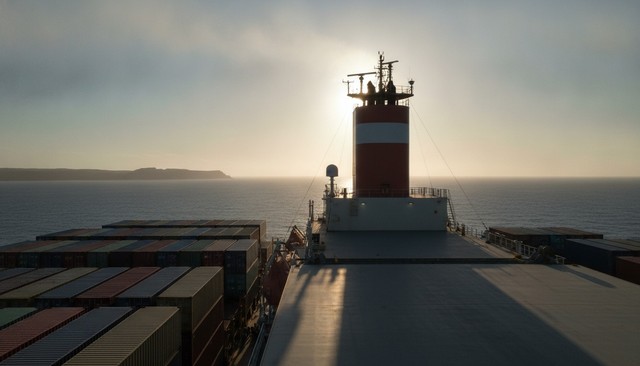
The EU Emissions Trading System reached full phase-in for shipping this year, meaning carriers now surrender allowances for 100% of in-scope voyage emissions. It arrives in the same year that most Asia–Europe traffic is still burning roughly 30% more fuel by sailing around the Cape.
Carbon Footprint
11 September 2026 • 5 min read
A Shanghai to Hamburg voyage via the Cape of Good Hope emits about 38% more CO2e than the same voyage through Suez. With EU ETS obligations now at 100%, that additional carbon is a priced line item rather than an environmental footnote — and it shows up on SADC exporters' invoices.
Maritime coverage under the EU ETS began at 40% of reported in-scope emissions in 2024, rose to 70% in 2025 and reaches 100% in 2026. From this year the scheme also covers methane and nitrous oxide alongside carbon dioxide, broadening the emissions base as well as the surrender rate. There is no further ramp remaining; what operators see now is the full obligation.
Carriers recover this through emission surcharges. On the benchmark Asia–North Europe lane the EU ETS surcharge has been running at approximately US$168 per 40ft container, equivalent to roughly 6–7% of the base freight rate. At carrier level, one published calculation for a 20,000 TEU vessel sailing Singapore to Rotterdam via the Cape puts the cost at about €45 per TEU.
Routing penalty: Shanghai–Hamburg via the Cape emits about 38% more CO2e than via Suez, and Cape diversions burn roughly 30% more fuel — with the Asia–North Europe ETS surcharge at about US$168 per 40ft container. (Source: Searoutes, 2026)
The routing decision and the carbon cost compound. A Cape passage burns roughly 30% more fuel than the Suez transit it replaces, and a Shanghai–Hamburg sailing via the Cape emits about 38% more CO2e. Because the ETS is levied on emissions, the extra distance is charged twice: once as bunkers and again as allowances. The published figures give a sense of scale — a Busan to Rotterdam voyage on a 10,000 TEU ship under Cape routing has been estimated at roughly €350,000 to €400,000 in ETS compliance cost, while the annual operating cost of an average bulk carrier trading within the EU rises by around €1.3 million in 2026.
The allowance price itself remains a variable. Deutsche Bank has indicated a plausible 2026 EU carbon price range of €60 to €150 depending on market conditions — a spread wide enough that an identical voyage can carry very different surcharges across a single contract year.
Southern African exporters shipping into the European Union are in scope for the voyage leg that touches EU ports, and the region's export basket — citrus and deciduous fruit, minerals and concentrates, vehicles and components, wine — is weighted toward Europe. A citrus exporter is therefore paying a carbon cost that varies with routing decisions made by a carrier in another hemisphere, on a lane the exporter does not control.
The practical defence is documentation. Emission surcharges are calculated from voyage data, routing and allowance prices, all of which are auditable in principle. An exporter who can tie a surcharge to a specific routing and a specific allowance price is in a position to challenge it or to shift volume to a carrier running the shorter route. An exporter who treats it as a fixed line item has no such leverage, and inherits every routing decision at full cost.
Forwarders and exporters shipping to the EU should request the calculation basis behind every emission surcharge — routing, in-scope distance and the allowance price applied — and audit it rather than accept it as a pass-through. Where a carrier has moved a service back through Suez, the surcharge should fall, and that is a legitimate point to raise at the next rate review.
Stay connected with Southern Africa's freight and transport community.
Join 6,400+ logistics professionals across the SADC region.
Visit Laaimylorrie.com| About the Author | |

|
Andre Klynsmith Entrepreneur & Technology Enthusiast Andre's expertise spans technology, blockchain, transport, and logistics — with a passion for innovation and driving positive change across industries. |
| Source: Searoutes — EU ETS Surcharges 2026: What Shippers Should Audit View source › | 28 May 2026 |


Subscribe to our Newsletter and stay in the know with all the latest Industry News, Products and Trends covering the whole of the SADC region.
KS Blockchain T/A Laaimylorrie.com . All Rights Reserved.