Industry related headlines to keep you in the know.
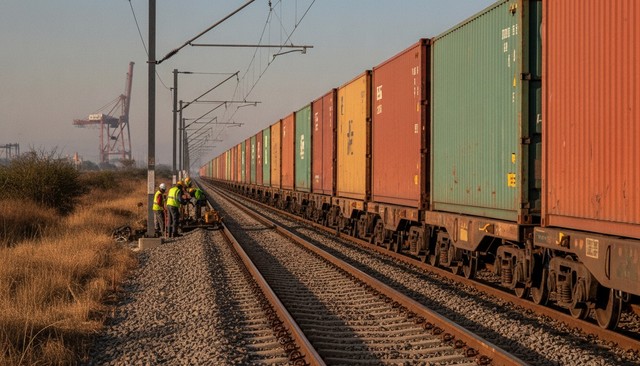
Transnet spent 85% of its R23.3 billion capital budget in the 2025/26 financial year on replacing and refurbishing assets it already owns. Only 15% went to expansion.
Asset Management
11 September 2026 • 4 min read
A capital budget is a statement of intent, and Transnet's 2025/26 numbers say the priority is reliability before growth. For anyone planning volumes on South African rail and port infrastructure over the next three years, that split matters more than the headline rand figure.
Chief Financial Officer Nosipho Maphumulo disclosed the allocation at the group's annual financial results presentation on 10 September. Of the R23.3 billion invested, 85% went to replacement and refurbishment of existing assets and 15% to expansion. Some 71% of the total was directed at the rail businesses, including Transnet Freight Rail and the Transnet Rail Infrastructure Manager.
Transnet had targeted R25 billion and fell R1.7 billion short. Actual investment was also down on the R24 billion spent in 2024/25. Maphumulo framed the renewal weighting as a deliberate focus on making existing assets reliable enough to carry higher freight volumes — a defensible position for an operator recovering from a deep performance trough, but one that pushes new capacity further out.
Rail volumes: 167.9 million tonnes in 2025/26, up 4.9% from 160.1 million tonnes — still short of the 180 million tonne target, with 18.4 million tonnes recovered since the 2022/23 low. (Source: Transnet annual results via Freight News, 2026)
Group CEO Michelle Phillips pointed to agreements signed with original equipment manufacturers that have shortened procurement lead times. In the port environment, she said, the wait from order date to receipt of equipment has conventionally run 18 to 24 months, and the OEM agreements have cut that materially.
Phillips also said Cape Town Container Terminal is expected to commission remote-operated cranes by the end of the current financial year, which she described as a first for South Africa. That is an operating-model change delivered inside a renewal budget rather than an expansion one — the same asset base, worked differently.
Phillips said the long-term decline in rail volumes has been arrested and the next test is whether the improvement can be sustained at higher tonnages. Her economic argument is straightforward: the more volume moves, the cheaper the system becomes per tonne and the more sustainable the operator becomes.
The caution for cargo owners is the gap between 167.9 million tonnes achieved and 180 million tonnes targeted, closing at roughly eight million tonnes a year while capital investment declines two years running. A renewal-weighted budget buys availability, not headroom. Planning assumptions that depend on step-change rail capacity before 2028 are running ahead of the money.
Expect South African rail to become more reliable before it becomes bigger — which is good news for schedule integrity and neutral-to-negative for anyone hoping road volumes will shift off the N3 and N4 quickly. Price road capacity on the assumption that the modal split moves slowly, and treat shorter port equipment lead times as the near-term upside, since terminal handling rates can improve well before line capacity does.
Stay connected with Southern Africa's freight and transport community.
Join 6,400+ logistics professionals across the SADC region.
Visit Laaimylorrie.com| About the Author | |

|
Andre Klynsmith Entrepreneur & Technology Enthusiast Andre's expertise spans technology, blockchain, transport, and logistics — with a passion for innovation and driving positive change across industries. |
| Source: Freight News View source › | 10 September 2026 |


Subscribe to our Newsletter and stay in the know with all the latest Industry News, Products and Trends covering the whole of the SADC region.
KS Blockchain T/A Laaimylorrie.com . All Rights Reserved.