Industry related headlines to keep you in the know.
Customs weaknesses, false declarations and cross-border smuggling are helping drive an illicit South African economy estimated at R279.3 billion across 12 industries, according to an economic, fiscal and employment impact assessment commissioned by the Consumer Goods Council of South Africa and conducted by Econometrix.
POLITICS INSIGHT
9 September 2026 • 5 min read
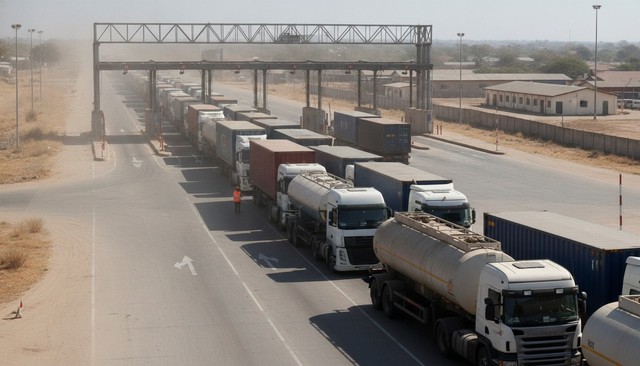
The report puts the annual fiscal loss at R68 billion in unpaid customs duties, VAT, excise and other levies. It names inspection constraints at Durban, Cape Town and Beitbridge among the vulnerabilities — the same three chokepoints that legitimate operators queue at every day.
The report, Illicit Trade in South Africa, estimates that illicit activity displaces R193 billion in formal business sales and removes R126 billion from gross domestic product annually, with R68 billion a year lost to the fiscus through unpaid customs duties, value-added tax, excise taxes and other levies. Mining accounts for the largest single illicit market identified at R60 billion, followed by unregulated online gambling at R55.1 billion, illicit tobacco at R45 billion and illicit alcohol.
Illicit alcohol is estimated at R39.8 billion when measured against the value of equivalent formal-market products, or R25.1 billion at prevailing illicit prices — with cross-border smuggling and round-tripping schemes used to avoid excise duties identified as key concerns. The clothing, textiles, footwear and leather sector is put at R20.4 billion annually, driven partly by customs under-invoicing and border evasion. Food, automotive fuel, chemicals, pharmaceuticals, non-alcoholic beverages, cosmetics and toys also feature.
The fiscal hole: R68 billion a year in unpaid customs duties, VAT, excise and other levies — against an illicit economy estimated at R279.3 billion across 12 industries. (Source: Econometrix for the Consumer Goods Council of South Africa, via Freight News, 2026)
Econometrix Director and Chief Economist Azar Jammine, speaking at a South African National Editors' Forum and CGCSA roundtable, said criminal networks exploit weaknesses in border management, customs systems and supply chains. "In several sectors, illicit trade is closely linked to organised criminal networks involved in customs fraud, smuggling, counterfeiting, money laundering and corruption," he said, adding that these networks operate across multiple industries and adapt their methods in response to the lack of enforcement activity.
The mechanics described in the report will be familiar to anyone who has worked a clearing desk: falsifying customs declarations, under-invoicing goods, concealing countries of origin and round-tripping consignments to obtain fraudulent duty drawbacks, with import, export and transit procedures manipulated through transhipment hubs including Dubai and Hong Kong. Customs misdeclaration, undervaluation and tariff fraud are identified as the major entry mechanisms. Inspection constraints at Durban, Cape Town and Beitbridge are named as vulnerabilities, and the report also alleges that corruption involving licensing authorities, border posts and inspection checkpoints facilitates the movement of illicit goods.
Econometrix Director and Chief Economist Johannes Jordaan was candid about methodology. "Just given the nature of illicit activities and the unknown component, the shadow markets, there isn't data available to work with specifically to calculate the size of the industry as you would do normally by going to Stats SA," he said. Researchers instead examined customs mirror trade discrepancies, official supply and use tables, seizure records, industry surveys and international comparisons to arrive at a defensible range per sector. The assessment was supported by social partners represented at Nedlac, including COSATU.
CGCSA Executive Neo Momodu called for stronger enforcement and the adoption of modern supply chain verification systems, arguing that South Africa needs to answer the question of when it will catch up with the rest of the world on the problem. Track and trace systems, GS1 global standards and digital product passports should be introduced across manufacturing and distribution chains alongside stronger law enforcement, Momodu said. That is a specific ask with a specific cost, and it lands on manufacturers, distributors and the logistics providers who move their goods.
Compliant operators already carry the cost of this problem in the form of blanket inspections, longer dwell times and reputational risk when a subcontracted load turns out to be misdeclared. Expect the policy response to push toward serialisation and track-and-trace obligations rather than more physical searching — so start assessing whether your systems can carry item- or consignment-level traceability data end to end. In the meantime, tighten client onboarding and consignment documentation checks: the report makes clear that origin concealment and under-invoicing are the entry points, and a forwarder who cannot evidence due diligence on a shipper is the easiest party to hold accountable.
Stay connected with Southern Africa's freight and transport community.
Join 6,400+ logistics professionals across the SADC region.
Visit Laaimylorrie.com| About the Author | |

|
Andre Klynsmith Entrepreneur & Technology Enthusiast Andre's expertise spans technology, blockchain, transport, and logistics — with a passion for innovation and driving positive change across industries. |
| Source: Freight News View source › | 8 September 2026 |


Subscribe to our Newsletter and stay in the know with all the latest Industry News, Products and Trends covering the whole of the SADC region.
KS Blockchain T/A Laaimylorrie.com . All Rights Reserved.