Industry related headlines to keep you in the know.
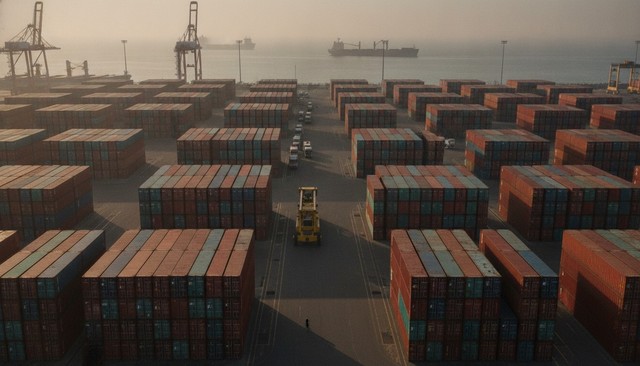
Stack occupancy at the Durban Gateway Terminal rose to 73.8% on 1 September, off the recent 89.2% peak but up again from the low recorded on Friday 28 August. The more revealing number in the same update from the South African Association of Freight Forwarders is that members reported individual container movements taking between 12 and 18 hours.
Cargo Handling
4 September 2026 • 5 min read
Nine vessels at anchorage, four working, none due to arrive, and two shipping lines deliberately holding ships back — yet the terminal still tightened. When the waterside stops adding boxes and the yard does not empty, the constraint is on the land side of the fence.
SAAFF's operational update described the recovery as fragile. Overall stack occupancy stood at 73.8%, with 5 766 road import containers on hand. Nine vessels were waiting at anchorage and four were working, with no additional arrivals reported as due. Two shipping lines had held vessels back specifically to give the terminal room to recover.
Read those figures together and the diagnosis is not subtle. A terminal with no inbound vessel pressure, four cranes-worth of work in progress and carriers voluntarily withholding tonnage should be draining. It was not. Occupancy had risen from the previous Friday's low, which means the rate at which boxes leave through the gate and over the rail is lower than the rate at which discharge and re-handles are putting them back into the stack.
Twenty-four hours of gate activity: 2 012 gate moves — 1 251 imports and 761 exports — plus a further 259 containers evacuated by rail, against 5 766 road import containers on hand. (Source: SAAFF via Freight News, 2026)
The sequencing matters, and SAAFF is careful about it. Congestion had been building since approximately 7 August — before the NAVIS N4 cutover. The migration then compounded existing yard, equipment, booking and landside evacuation constraints rather than creating them. Members reported containers sitting in stacks without usable bookings, which is the mechanism that converts a software event into a physical one: a box that cannot be booked cannot be collected, and a box that cannot be collected occupies a slot that the next discharge needs.
The association's own summary is the sentence operators should quote in their planning meetings: the immediate issue is not NAVIS alone, it is restoring fluidity across the entire terminal system. That framing has consequences for how long the disruption is expected to last. A system defect is fixed and the queue clears. A capacity and evacuation problem clears at the speed of trucks, cranes, bookings and rail slots — which is measured in weeks.
The reefer picture improved materially: reefer stack occupancy came down from 108% to 92%, with plug utilisation at 84%. Ground slot occupancy, however, remained at 99%. That combination is worth understanding before anyone declares the cold chain recovered. Plugs are the power constraint; ground slots are the physical constraint. At 99% ground slot occupancy the terminal has almost no room to place a box before it is plugged in or after it is unplugged, so a reefer arriving in that window has nowhere to stand even when a plug is technically free.
Export stack capacity showed some restoration, with firm openings for the SPIL Kartika and reefer-only stacks for the MSC Barbara and MSC Long Beach VI. SAAFF read this as recovery that remains controlled rather than open. Its stated priorities are restoring booking and evacuation capacity, rehabilitating the stacks and bringing additional equipment and operational capacity into the system, alongside using Pier 1 and the Multi-Purpose Terminal where practicable and strengthening rail evacuation. The association also flagged that waterside inflows may need to be moderated temporarily — a candid acknowledgement that the fastest route to a working terminal may be to accept fewer boxes for a while.
Plan trucks around the booking, not the vessel: with 12 to 18 hour movements reported, a slot you cannot confirm is a vehicle you should not dispatch, and idle trucks at the gate make the congestion worse for everyone. Push what you can onto rail — 259 boxes moved that way in a day and every one released a ground slot. And if you are moving reefers, ask about ground slot availability and not just plugs, because at 99% the terminal can be power-ready and space-short at the same time.
Stay connected with Southern Africa's freight and transport community.
Join 6,400+ logistics professionals across the SADC region.
Visit Laaimylorrie.com| About the Author | |

|
Andre Klynsmith Entrepreneur & Technology Enthusiast Andre's expertise spans technology, blockchain, transport, and logistics — with a passion for innovation and driving positive change across industries. |
| Source: Freight News View source › | 2 September 2026 |


Subscribe to our Newsletter and stay in the know with all the latest Industry News, Products and Trends covering the whole of the SADC region.
KS Blockchain T/A Laaimylorrie.com . All Rights Reserved.