Industry related headlines to keep you in the know.
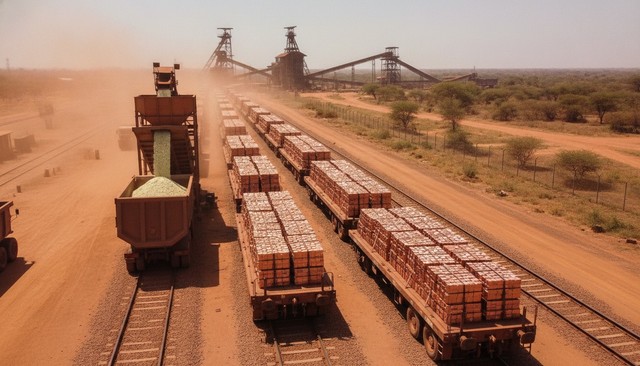
Zambia's target of three million tonnes of copper a year by 2031 translates into between 10 and 12 million tonnes of total commodity movement into and out of the Copperbelt, because every tonne of finished copper requires roughly three tonnes of lime and a tonne of sulphur to produce.
Mining and Commodities
1 September 2026 • 4 min read
The headline number everyone quotes is the copper. The number that matters to transporters is the inbound reagent traffic that has to arrive before the copper can leave. On current ratios, that is three to four times the tonnage of the metal itself.
Zambia is already approaching one million tonnes of annual copper production and has set a target of three million tonnes by 2031. Speaking at the Land-Linked Zambia conference, ZCCM-IH chairperson Phesto Musonda set out the ratio that turns a mining target into a logistics problem: for every tonne of copper produced, mines require approximately three tonnes of lime plus another tonne of sulphur, among other inputs.
Apply that to three million tonnes of output and the freight requirement lands between 10 and 12 million tonnes of commodities moving into and out of the mining regions. The export leg is the visible part. The inbound reagent leg is larger, less discussed, and just as capacity-constrained.
Input ratio: Roughly 3 tonnes of lime and 1 tonne of sulphur are required per tonne of copper produced, putting total freight demand at 10–12 million tonnes at a 3 Mt production level. (Source: ZCCM-IH via Freight News, 2026)
TAZARA managing director Bruno Ching'andu described the target as "an invitation and a challenge at the same time", and identified the structural problem plainly: mining and transport infrastructure planning have traditionally happened separately. Miners plan extraction; rail operators are not routinely brought to the table. The consequence is that transport capacity gets specified reactively, after volumes have already grown.
"When we start looking for the equipment to move these increased volumes, we don't have it," he said. "Readiness is going to be a challenge." Rolling stock, locomotives, tippers, tankers and skilled crews all have procurement lead times measured in years, not quarters.
The financing problem is circular. Investors are unlikely to fund transport infrastructure today purely on the expectation that Zambia produces three million tonnes in 2031. Standard Bank's head of trade development, Lester Anderson, expects capacity to be developed incrementally as a result — which means periods where volume outruns capacity rather than a smooth ramp.
TAZARA itself is under full rehabilitation, with construction on a new training centre and a modern operations control centre in Dar es Salaam having started in July 2026 under the revitalisation project. But rail alone will not absorb the growth. Musonda stressed that customs, security and border processes must also work efficiently at higher volumes, and that road and rail need to operate intermodally rather than compete for the same cargo.
Incremental rail capacity against a steep production ramp means road freight carries the gap — and the gap is concentrated in inbound bulk reagents, not just outbound metal. Operators with tipper, tanker or bulk capability on the Copperbelt routes should be talking to mine procurement teams about multi-year inbound contracts now, while capacity is still being specified. Backhaul planning matters more than usual here: a loaded inbound lime run paired with a loaded outbound copper run is the difference between a viable rate and a loss-making one on these distances.
Stay connected with Southern Africa's freight and transport community.
Join 6,400+ logistics professionals across the SADC region.
Visit Laaimylorrie.com| About the Author | |

|
Andre Klynsmith Entrepreneur & Technology Enthusiast Andre's expertise spans technology, blockchain, transport, and logistics — with a passion for innovation and driving positive change across industries. |
| Source: Freight News View source › | 21 August 2026 |


Subscribe to our Newsletter and stay in the know with all the latest Industry News, Products and Trends covering the whole of the SADC region.
KS Blockchain T/A Laaimylorrie.com . All Rights Reserved.