Industry related headlines to keep you in the know.
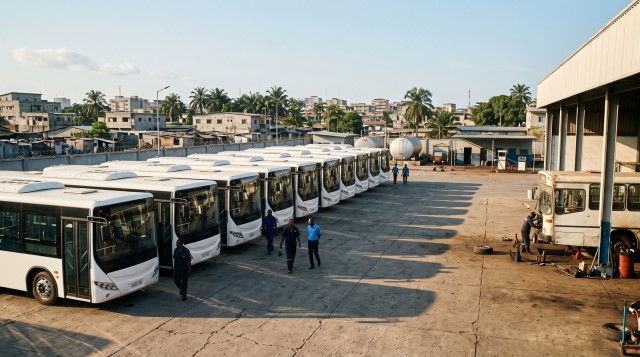
Congolese public transport operator TRANSCO took delivery of 30 Mercedes-Benz buses in Kinshasa on 25 August 2026, bringing deliveries under its partnership with Suprême Automobile to 180 of a planned 230 units. The operator said the vehicles would enter service within 48 hours.
Public Transport
30 August 2026 • 4 min read
Thirty buses arriving is a photograph. Thirty buses still running in eighteen months is an operation. TRANSCO's own framing of the delivery — utilisation, maintenance, depot capacity, parts — is the more useful part of this story for any SADC fleet owner.
The buses were handed over at TRANSCO's second Kinshasa depot in the presence of Transport Minister Jean-Pierre Bemba Gombo and TRANSCO Managing Director Jérémie Kilubu Matondo. The batch forms part of a fleet renewal and expansion programme with Suprême Automobile that will add 230 vehicles in total, with 50 still outstanding.
The stated 48-hour turnaround from delivery to revenue service is unusual and worth noting. Most fleet additions across the region sit for weeks between handover and deployment while licensing, branding, driver allocation and depot space are sorted out. Compressing that window is itself an operational capability.
Programme progress: 180 of 230 planned buses delivered, with 50 units outstanding; the latest 30 units were scheduled into service within 48 hours of handover. (Source: TRANSCO / Logis-T Africa, 2026)
TRANSCO is simultaneously working on digitalising its operations, shifting parts of its processes from physical systems to digital tools, and is considering acquiring minibuses for secondary routes that standard buses cannot serve well. Both moves point at the same recognition: fleet size alone does not produce service.
Every additional bus adds a claim on spare parts inventory, preventive maintenance slots, depot space, driver rosters and fuel management. A 230-vehicle programme delivered into a depot system sized for 100 produces a growing pool of immobilised assets, not a growing service. The same arithmetic applies to a 40-truck haulier adding ten units.
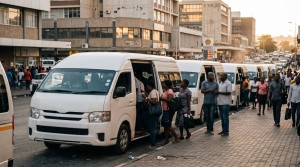
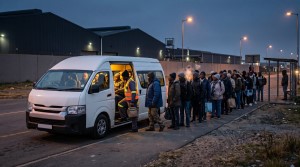
Urban commuter capacity is a labour-supply variable for warehousing and distribution. Where public transport is short, workers arrive late, shifts start ragged and night-shift staffing becomes difficult to fill at any wage. Kinshasa is an extreme case, but the mechanism is identical in Johannesburg, Lusaka, Harare and Windhoek.
The route-segmentation thinking is also transferable. TRANSCO's plan to run minibuses on secondary routes rather than forcing full-size vehicles down unsuitable roads is the passenger-side version of matching vehicle class to lane — the same discipline that stops operators sending a superlink where a rigid would do the job cheaper and faster.
Before your next fleet expansion, check the three constraints TRANSCO is naming out loud: do you have the parts holding, the workshop capacity and the driver pool to keep the new units productive? If any one of those is already tight, the additional vehicles will raise your cost per productive kilometre rather than lower it. And if you run a Kinshasa or wider DRC operation, expect gradual improvement in staff commute reliability over the next 12 months rather than an immediate change.
Stay connected with Southern Africa's freight and transport community.
Join 6,400+ logistics professionals across the SADC region.
Visit Laaimylorrie.com| About the Author | |

|
Andre Klynsmith Entrepreneur & Technology Enthusiast Andre's expertise spans technology, blockchain, transport, and logistics -- with a passion for innovation and driving positive change across industries. |
| Source: Logis-T Africa View source › | 28 August 2026 |


Subscribe to our Newsletter and stay in the know with all the latest Industry News, Products and Trends covering the whole of the SADC region.
KS Blockchain T/A Laaimylorrie.com . All Rights Reserved.