Industry related headlines to keep you in the know.
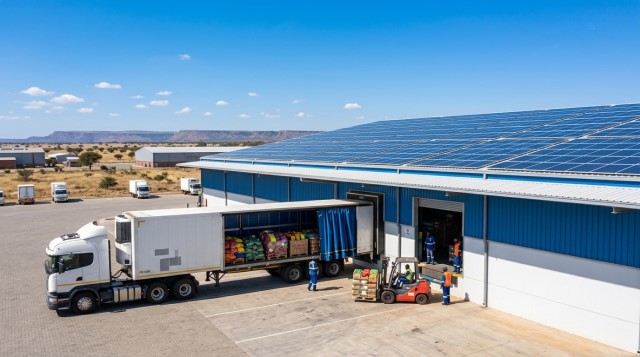
SADC's cold-chain warehouse network is no longer a collection of isolated facilities — it is becoming an integrated cross-border infrastructure layer, anchored by a Lusaka cold store, supported by South African transit hubs and increasingly powered by Botswana's renewable-energy grid.
WAREHOUSING AND STORAGE
1 May 2026 • 4 min read
Three trends are converging in SADC cold-chain storage: a regional hub-and-spoke model centred on Lusaka, cross-border transit times of 72-96 hours into Zambia via Zimbabwe or Botswana, and Botswana's solar endowment positioning the country as a low-carbon refrigeration hub. Operators that see the network — not the building — will win the next decade of contracts.
DP World's Deep Catch group operates the Lusaka Commercial Cold Store (LCCS), a facility purpose-built to anchor Zambia's cold-chain network. What makes this facility strategic is not its standalone capacity — it is the role it plays in a hub-and-spoke pattern stretching from Walvis Bay and Cape Town into Lusaka, then onward into the DRC Copperbelt and Zambia's North-Western Province. With cross-border transit times of 72-96 hours from South Africa via Zimbabwe or Botswana, a regional anchor in Lusaka materially reduces the total temperature-excursion exposure of any reefer shipment.
Service providers offering geographical presence across South Africa, Namibia, Botswana, Malawi, Zambia and Zimbabwe are the second piece of the network. The cold-chain economics of 2026 reward operators who can offer a single contract covering origin pick-up, cross-border clearance, mid-route storage and last-mile delivery — a model that requires owned or partner-managed cold rooms in at least three SADC capitals.
Industry figure: The Africa cold chain market is projected at USD 15.03 billion in 2026, scaling to USD 18.29 billion by 2031 at a 4.02% CAGR. South Africa accounts for an estimated 30.55% of regional capacity. (Source: Mordor Intelligence / GCCA, 2026)
Botswana's strategic position at the centre of southern Africa is now being amplified by an emerging energy story. The country's solar irradiance levels are among the world's highest, and a renewables build-out is now opening up a new model for the cold-chain sector: solar-powered or solar-augmented refrigerated warehousing along the Trans-Kalahari corridor, where energy cost has historically been the largest single operating expense.
For operators with multi-country footprints, this is a structural change. A cold store in Gaborone or Francistown that runs on a 70-80% solar mix has a fundamentally different cost-per-pallet-day than a Johannesburg facility on grid power, and that delta will only widen as Eskom tariff escalations continue. Cross-border cold-chain network design in 2026 is no longer purely a transit-time optimisation; it is also an energy-cost arbitrage.
The third leg of the cross-border cold-chain story is compliance. Routes from South Africa into Zimbabwe, Botswana, Mozambique, Namibia and Zambia all require additional permits, customs documentation and longer transit planning. The Global Cold Chain Alliance's 2026 work continues to flag regulatory inconsistency as the single largest barrier to capital investment in SADC refrigerated infrastructure — ahead of energy cost or skills.
Bonded warehousing layered onto cold storage is the answer that is now scaling. A bonded reefer facility allows duty deferral on pharmaceuticals, perishables and temperature-controlled FMCG, freeing up working capital and removing the rush-clearance pressure that historically caused cold-chain breaches. With AfCFTA preferential tariff schedules now phasing in, the documentary lift required to claim eCOO benefits has become non-trivial — and operators offering bonded cold-chain storage with end-to-end documentary support are pricing 12-18% above non-bonded competition.
Treat your 2026 cold-chain proposition as a network, not a building. If your existing footprint cannot offer a Lusaka, Gaborone or Windhoek midpoint, partner before you compete — and price renewable-energy savings into your pallet-day rates where the host country grid is solar-augmented. Customers buying cold storage in 2026 are increasingly buying corridor reliability and energy resilience, not just temperature-controlled square metres.
Stay connected with Southern Africa's freight and transport community.
Join 6,400+ logistics professionals across the SADC region.
Visit Laaimylorrie.com| About the Author | |

|
Andre Klynsmith Entrepreneur & Technology Enthusiast Andre's expertise spans technology, blockchain, transport, and logistics — with a passion for innovation and driving positive change across industries. |
| Source: Cold Link Africa — Botswana's solar endowment and the emerging regional energy hub View source › | 1 May 2026 |


Subscribe to our Newsletter and stay in the know with all the latest Industry News, Products and Trends covering the whole of the SADC region.
KS Blockchain T/A Laaimylorrie.com . All Rights Reserved.