Industry related headlines to keep you in the know.
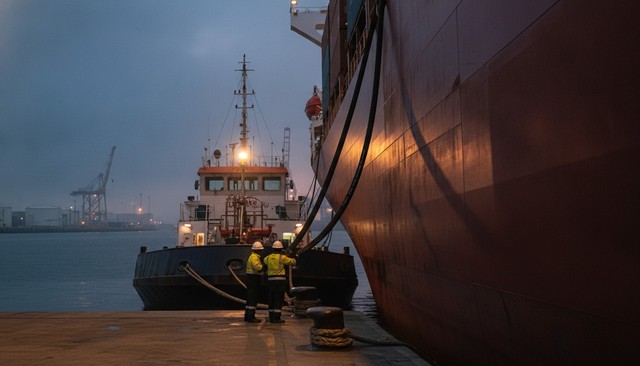
Brent crude traded above US$100 a barrel on 10 September for the first time in two months, and marine fuel prices at Durban rose across every grade on the same session — a combination that lands directly on the cost of moving cargo around the Cape.
Economy and Markets
14 September 2026 • 4 min read
Ocean freight rates on the Southern African lane have been broadly flat for weeks. Bunkers have not. When the base rate stops moving and the fuel component keeps climbing, the number on your invoice still goes up — it just stops being visible in the rate you negotiated.
The front-month ICE Brent contract gained US$1.94 a barrel on the day to trade at US$102.30 at 09:00 GMT on 10 September 2026, according to bunker market intelligence provider ENGINE. It was the first time Brent had cleared the US$100 mark in two months, and the move was attributed almost entirely to geopolitical risk rather than to any change in physical demand.
Durban tracked it across the board. Very-low sulphur fuel oil rose US$15 per tonne, low-sulphur marine gasoil rose US$36 per tonne and high-sulphur fuel oil rose US$18 per tonne in a single session. The distillate move is the one to watch: LSMGO climbed more than twice as fast as VLSFO, which widens the distillate premium and raises the cost of the auxiliary and manoeuvring fuel burned in port rather than at sea.
Single-session move: Brent front-month up US$1.94/bbl to US$102.30/bbl; Durban VLSFO up US$15/mt, LSMGO up US$36/mt and HSFO up US$18/mt. (Source: ENGINE Europe & Africa Market Update, 10 September 2026)
Analysts at ING Bank, quoted in the same market update, described the market as pricing in persistent geopolitical risk with no viable path to de-escalation between the United States and Iran, adding that current signals point to further escalation. In the week to 10 September, US Central Command said it had destroyed ten Iranian tankers described as part of a shadow-fleet network.
That distinction matters for anyone forecasting costs. A fuel price driven by strong demand tends to move with the economic cycle and can be hedged against known seasonal patterns. A fuel price driven by the removal of tonnage and the closure of a waterway moves on headlines, in steps, and without warning. It can also fall just as abruptly, which is precisely why it is a poor basis for a twelve-month fixed quote in either direction.
Marine fuel reaches Southern African cargo owners through the bunker adjustment factor and emergency fuel surcharges applied to ocean freight, and it reaches them a second time through the cost of the vessels calling at regional ports for bunkers alone. Because Cape routing adds roughly 10 to 14 days to an Asia–Europe voyage, every dollar per tonne on bunkers is multiplied across a longer burn than it would have been on a Suez rotation.
The practical failure mode is not the increase itself. It is the increase arriving inside a quote that appears unchanged. A carrier or forwarder holding a headline rate steady while raising the fuel component gives the impression of price stability while transferring the whole of the volatility to the customer. Operators who cannot see the split cannot budget, cannot benchmark and cannot argue.
Insist that every quote shows base freight, bunker adjustment and war-risk components as separate lines — a single all-in number hides which part is moving and makes year-on-year comparison meaningless. Shorten quote validity to a few days on volatile lanes rather than accepting a padded longer-dated rate. And when you renew an annual contract, agree the indexation mechanism and the reference index in advance, so the fuel adjustment is a formula both sides can check rather than a number one side announces.
Stay connected with Southern Africa's freight and transport community.
Join 6,400+ logistics professionals across the SADC region.
Visit Laaimylorrie.com| About the Author | |

|
Andre Klynsmith Entrepreneur & Technology Enthusiast Andre's expertise spans technology, blockchain, transport, and logistics — with a passion for innovation and driving positive change across industries. |
| Source: ENGINE — Europe & Africa Bunker Market Update View source › | 10 September 2026 |


Subscribe to our Newsletter and stay in the know with all the latest Industry News, Products and Trends covering the whole of the SADC region.
KS Blockchain T/A Laaimylorrie.com . All Rights Reserved.