Industry related headlines to keep you in the know.
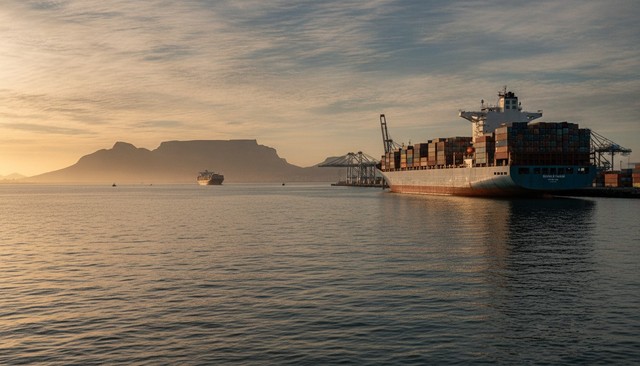
Cape of Good Hope routing has lifted South African port calls by roughly 25% year on year, but the extra traffic has not landed evenly across the coast — and carriers are now cutting calls to protect schedules rather than adding capacity to absorb them.
Ports and Terminals
14 September 2026 • 4 min read
The Cape route has stopped being a detour and become the default. For Southern African shippers that is not simply more ships passing by — it is a live reshuffling of which ports are worth routing cargo through, and which transhipment legs will still exist next month.
With the Strait of Hormuz effectively shut and Red Sea transits still only partially restored, the sea route around Southern Africa is carrying volumes it was never planned for. A monthly Africa trade-lane analysis published by freight forwarder Great Hensen on 20 August 2026 put the increase in South African port calls attributable to Cape routing at about 25% year on year, alongside a marked rise in bunkering demand.
The problem is that ultra-large container vessel arrivals have outrun the infrastructure available to turn them. The same analysis rated Cape Town as relatively stable, with essentially zero waiting time but continued exposure to wind delays and deciduous-season reefer peaks, and Port Elizabeth as the steadiest of the three at roughly one day. Durban remains the variable. Extra calls are not the same thing as extra capacity, and a coast that receives more ships without more berth hours simply redistributes the queue.
Lane reading: South African port calls up about 25% year on year under Cape routing, with all-in Durban and Cape Town rates at US$3,015–3,685 per 40ft box and the SCFI South Africa sub-index at 2,791 USD/TEU in the week of 7 August 2026. (Source: Great Hensen Africa trade-lane analysis, 2026)
The most consequential detail for SADC cargo owners is not a rate or a waiting time. It is that Maersk and CMA CGM dropped Port Louis calls on the Safari service in order to keep the rest of the rotation on time. That is the standard response when a string runs late: the port that gets omitted is the one carrying the least cargo on that voyage, which is almost always a transhipment or feeder call rather than a main gateway.
For an importer whose box is routed via a transhipment hub, an omitted call is not a delay of hours. It is a wait for the next connecting vessel, which on a weekly service means seven days, and on a fortnightly feeder means fourteen. Direct-call cargo absorbs congestion; transhipment cargo absorbs congestion plus the risk that its second leg disappears without notice.
On the eastern side of the region, Mombasa and Dar es Salaam have been the clearest winners of sustained rerouting, handling record transhipment volumes for East and Central Africa. Tanzania's terminal partnership with DP World is credited with compressing cargo turnaround from around 30 days to between 36 and 48 hours — a step change that makes the Central Corridor a genuine option for cargo that would previously have gone south by default. Mombasa all-in rates of US$4,800–5,000 per 40ft reflect that demand.
On the western side, Walvis Bay's container terminal was built to take annual capacity from 350,000 TEU to 750,000 TEU and has spare room by regional standards, with the Trans-Kalahari and Walvis Bay–Ndola–Lubumbashi corridors running inland from it. The practical consequence is that for a landlocked importer in Zambia, Botswana, Zimbabwe or the DRC, gateway selection has become a genuine commercial decision rather than an inherited habit — and it is a decision that can be re-taken every quarter.
Ask your forwarder to state, in writing, whether your booking is a direct call or a transhipment, and what the connecting service is — an omitted feeder call costs a full service cycle, not a day. Price at least one alternative gateway for every inland destination you serve, including the road or rail leg, so the comparison is landed cost rather than ocean freight. And review that comparison quarterly: the port that was right in March is not automatically right in October.
Stay connected with Southern Africa's freight and transport community.
Join 6,400+ logistics professionals across the SADC region.
Visit Laaimylorrie.com| About the Author | |

|
Andre Klynsmith Entrepreneur & Technology Enthusiast Andre's expertise spans technology, blockchain, transport, and logistics — with a passion for innovation and driving positive change across industries. |
| Source: Great Hensen — Africa Shipping Rates August 2026 Deep Analysis View source › | 20 August 2026 |


Subscribe to our Newsletter and stay in the know with all the latest Industry News, Products and Trends covering the whole of the SADC region.
KS Blockchain T/A Laaimylorrie.com . All Rights Reserved.